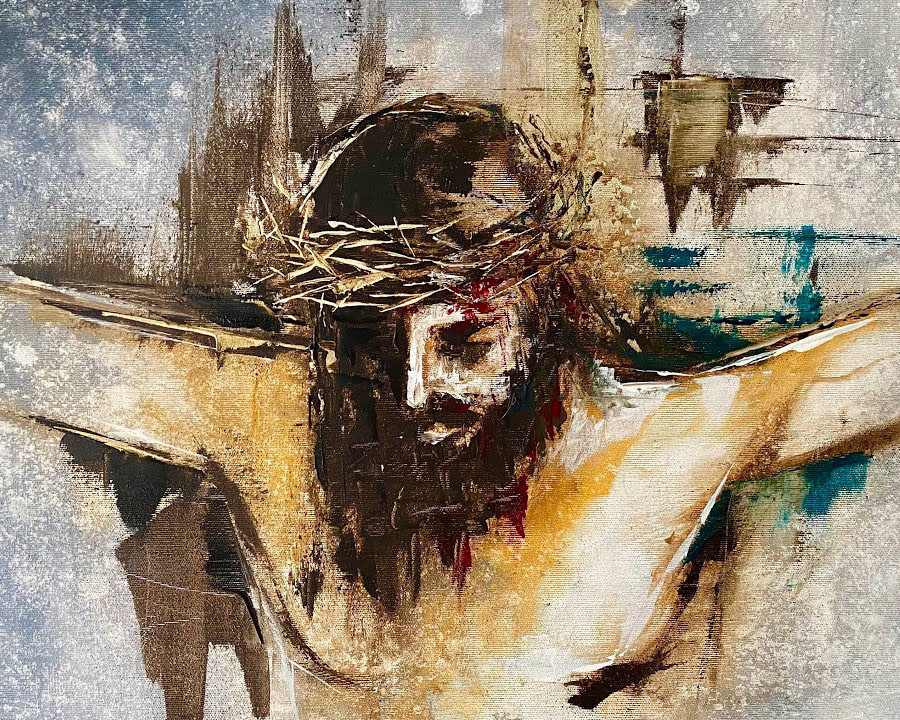
PALM SUNDAY, YEAR A
Matthew 27:11-54
In the Gospel of Matthew 27:11–54, we are brought face-to-face with one of the most powerful and sobering scenes in all of Scripture: the trial, suffering, and crucifixion of Jesus. This passage forces us to wrestle with a question that echoes throughout: Who is this man?
At the beginning of the passage, Jesus stands before Pilate. The Roman governor asks Him plainly, “Are you the King of the Jews?” And Jesus responds, “You have said so.”
It’s striking. Jesus doesn’t defend Himself. He doesn’t argue. He doesn’t try to escape. While accusations are hurled at Him, He remains silent. Pilate is amazed—not because Jesus is weak, but because He is completely in control.
This is our first truth: Jesus is a King—but not the kind people expected.
The crowd wanted a political saviour. The religious leaders wanted control. Pilate wanted order. But Jesus came to bring something far deeper: salvation from sin. His kingdom is not built on force, but on sacrifice.
And yet, despite His innocence, the crowd chooses Barabbas—a known criminal—over Jesus. When Pilate asks, “What shall I do with Jesus who is called Christ?” they shout, “Crucify Him!”
Here we see something deeply uncomfortable: humanity’s rejection of God.
It’s easy to point fingers at the crowd, but if we’re honest, we recognise ourselves here. We, too, often choose what is broken over what is holy. We choose our own way over God’s way. The cry “Crucify Him!” echoes in every act of rebellion, every moment we turn away from truth.
And so Pilate, though he knows Jesus is innocent, gives in to the pressure. He washes his hands, as if to say, “I’m not responsible.”
But the reality is: no one in this story is truly innocent—except Jesus.
Then comes the suffering.
The soldiers mock Him. They dress Him in a scarlet robe, press a crown of thorns onto His head, and kneel before Him in cruel imitation: “Hail, King of the Jews!” They strike Him, spit on Him, and lead Him away to be crucified.
This is the second truth: the King is mocked before He is glorified.
The irony is profound. Everything they do in mockery is actually true. He is a King. That crown, though made of thorns, points to His authority. That robe, though placed in jest, hints at His royalty.
But His throne will not be in a palace—it will be a cross.
As Jesus is led to Golgotha, He is too weak to carry His cross, and a man named Simon is forced to carry it for Him. Even here, we see a picture of discipleship: to follow Jesus is to take up the cross.
When they crucify Him, they divide His garments and cast lots. Above His head, they place the charge: “This is Jesus, the King of the Jews.”
Again, meant as mockery—but it proclaims the truth.
Even as He hangs there, people pass by and insult Him: “If you are the Son of God, come down from the cross!”
But this is the great paradox of the Gospel: Jesus doesn’t save Himself, because He is saving us.
If He had come down from the cross, we would have no hope. His power is not shown in escaping suffering, but in enduring it for our sake.
For hours, darkness covers the land. And then Jesus cries out, “My God, my God, why have you forsaken me?”
These are not words of despair alone—they are the opening line of Psalm 22, a psalm that ultimately points to victory. But in this moment, Jesus is experiencing the weight of sin, the separation that sin brings.
This is the third truth: on the cross, Jesus takes our place.
He bears the judgment we deserve. He enters into our brokenness, our guilt, our separation from God.
And then, with a loud cry, He gives up His spirit.
At that moment, something extraordinary happens. The curtain of the temple is torn in two—from top to bottom. The earth shakes. Rocks split. Tombs open.
And a Roman centurion—an outsider, a witness to it all—makes a stunning declaration: “Truly this was the Son of God.”
This is our final truth: the cross reveals who Jesus truly is.
Not just a teacher. Not just a prophet. But the Son of God.
The torn curtain is especially significant. In the temple, that curtain separated people from the Holy of Holies—the place where God’s presence dwelled. Only the high priest could enter, and only once a year.
But now, through Jesus’ death, that barrier is removed. Access to God is opened.
No longer is there separation. No longer is there distance. Through the cross, we are invited into relationship with God.
So what does this mean for us?
First, it calls us to recognise Jesus as King—not just in name, but in our lives. A King demands allegiance. Will we follow Him?
Second, it calls us to face the reality of sin. The cross shows us both the seriousness of our sin and the depth of God’s love. We are more broken than we realise—but more loved than we can ever imagine.
Third, it invites us to receive the grace Jesus offers. He took our place so that we could be forgiven, restored, and made new.
And finally, it challenges us to respond. The centurion saw what happened and declared, “Truly this was the Son of God.”
That same question stands before us today: Who do you say that Jesus is?
Is He just a figure in history? A moral teacher? Or is He your King and Saviour?
Because the cross demands a response.
The King has come. The King has suffered. The King has died.
And through His death, He has made a way for us to live.
In the name of the Father, and of the Son, and of the Holy Spirit. Amen.
Cover image artist – Chris Leloudis

 Rev Beck Newell