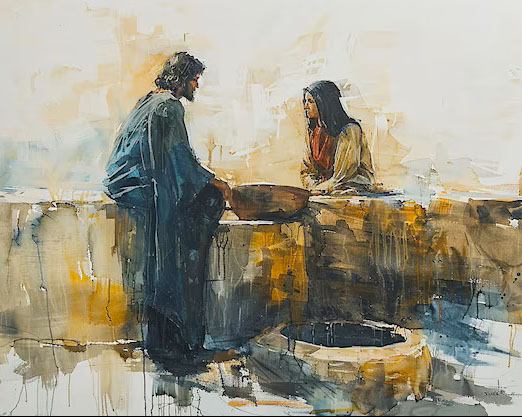
LENT 3, YEAR A
John 4:5-42
One of the deepest needs every human being shares is thirst. Not only physical thirst, but spiritual thirst. People thirst for meaning, acceptance, forgiveness, love, and hope.
In this passage from the Gospel of John, Jesus Christ meets a woman whose life represents that thirst—and He offers her something that satisfies forever.
The story begins with Jesus traveling through Samaria, stopping near a town called Sychar, at Jacob’s Well. At noon, a Samaritan woman comes to draw water. That moment alone is remarkable. Jews and Samaritans had deep hostility. Jewish teachers normally avoided speaking with women in public. Yet Jesus deliberately crosses cultural, ethnic, and social barriers to speak with her.
He simply says: “Give me a drink.” The Son of God begins with a humble request.
This reminds us of something powerful: Jesus meets people right where they are.
Not after they clean up their lives. Not after they become respectable. But in the ordinary places—wells, workplaces, kitchens, and streets. No one is outside His reach.
As the conversation unfolds, Jesus speaks about “living water.” The woman is confused at first. She thinks Jesus is talking about physical water. But He explains that the water He gives will become a spring of eternal life.
Then Jesus gently reveals that she has had five husbands and is living with a man who is not her husband. He isn’t exposing her to shame her. He’s revealing something deeper: her thirst. She has been searching for fulfillment through relationships, hoping each new situation might finally satisfy her heart.
Every human being does something similar. People try to quench spiritual thirst with success. relationships, possessions, pleasure, or status. But these things are like drinking salt water. The more we consume, the thirstier we become.
Jesus’ point is simple: only God can satisfy the human soul.
When the woman realises Jesus is a prophet, she raises a theological debate: where should people worship—on the Samaritan mountain or in Jerusalem? Jesus answers with a revolutionary statement: “True worshipers will worship the Father in spirit and truth.” In other words, worship isn’t primarily about a place. It’s about a relationship with God. Through Jesus, people can approach God directly. Real worship happens when our hearts respond to who God truly is.
The woman then speaks about the coming Messiah. Jesus responds with one of the clearest declarations in the entire Gospel: “I who speak to you am he.”
To an outsider. To a Samaritan. To a woman with a painful past.
The first person in this Gospel to hear such a direct claim is not a religious leader—but someone society might overlook. This reveals something beautiful about the heart of Christ: grace comes before status.
After this conversation, the woman leaves her water jar and runs back to town. She tells everyone: “Come, see a man who told me everything I ever did. Could this be the Christ?” Because of her testimony, many people from Sychar come to meet Jesus. After hearing Him themselves, they declare: “This man really is the Saviour of the world.”
Think about the transformation:
She came to the well alone and ashamed. She left bold and joyful, telling everyone about Jesus. The person who once avoided the community becomes the first
missionary to it. That’s what happens when someone encounters the living water.
There are three lessons (at least) in this text for us today:
Firstly, Jesus seeks the thirsty. No one is too far away, too broken, or too complicated. Jesus intentionally seeks people who are spiritually thirsty.
Secondly, only Christ can satisfy the soul. Every human heart has a deep longing that cannot be filled by success, relationships, or pleasure. The living water Jesus gives is
eternal life with God.
Thirdly, transformed people become witnesses. The Samaritan woman didn’t attend a training course or seminary. She simply told people what Jesus had done. The most powerful testimony is often the simplest: “Come and see.”
In conclusion, in this story at Jacob’s Well, two kinds of water appear. One kind temporarily satisfies physical thirst. The other—offered by Jesus Christ—becomes a spring of eternal life.
Every person must choose which well they will draw from.
The invitation of Jesus still stands today: “Whoever drinks the water I give them will never thirst.” And when someone truly receives that living water, it doesn’t stay
contained—it begins to overflow into the lives of others.
In the name of the Father, and of the Son, and of the Holy Spirit. Amen.
Cover image artist – Roberto Baumgartel

 Rev Beck Newell