LENT 5, YEAR A
John 11:1-45
There’s a question buried in this passage that many people are afraid to say out loud: What do we do when God seems late?
In John 11, we meet a family Jesus deeply loves—Mary, Martha, and their brother Lazarus. Lazarus is sick, and the sisters send word to Jesus: “Lord, the one you love is sick.” It’s not just information—it’s a plea. Come now.
But what does Jesus do? He waits.
Scripture says He stayed where He was two more days. And by the time He arrives, Lazarus has been in the tomb for four days. From the sisters’ perspective, Jesus didn’t just delay—He missed the moment.
Martha meets Him first and says what many of us have felt: “Lord, if you had been here, my brother would not have died.” Mary says the same thing. That sentence carries grief, faith, and disappointment all at once.
Jesus wasn’t absent because He didn’t care. In fact, the text tells us plainly: “Jesus loved Martha and her sister and Lazarus.” And then it says: “So… He stayed two more days.” That’s not how we expect the sentence to go. We would think love means immediate action. But here, love includes delay. Why?
Because Jesus is working on a bigger timeline than we can see. Jesus says earlier, “This sickness will not end in death, but for God’s glory.” That doesn’t mean Lazarus won’t die—he does. It means death won’t have the final word.
Sometimes what feels like God’s silence is actually God setting the stage for something greater than we could have imagined.
Martha is often portrayed as the practical one, but here she shows deep faith. Even in her grief, she says, “I know that even now God will give you whatever you ask.” She doesn’t fully understand—but she still trusts. And Mary? She falls at Jesus’ feet weeping. Two different responses: one speaks theology, one expresses raw emotion. Jesus receives both.
That matters. Because sometimes we think faith means having it all together. But this passage shows us that faith can look like questions, tears, and even disappointment.
God is not put off by your honesty.
One of the most powerful verses in the Bible is here: “Jesus wept.”
Think about that.
Jesus knows He is about to raise Lazarus. He knows resurrection is moments away. And yet—He weeps. Why?
Because He is not distant from human pain. He doesn’t stand outside suffering offering explanations—He steps into it. He sees Mary’s tears. He sees the mourners. He feels the weight of death in the world. And He is “deeply moved.”
This tells us something profound: God doesn’t just fix pain—He feels it. If you’ve ever wondered whether God understands your grief, this passage answers clearly: He does.
When Jesus arrives at the tomb, He gives a surprising command: “Take away the stone.” Martha hesitates. She points out the reality—it’s been four days; there will be a smell. In other words: this situation is beyond hope.
But Jesus insists. Before the miracle happens, the stone has to be moved.
Sometimes God calls us to participate in what He’s about to do—even when it feels uncomfortable or pointless. The people around the tomb couldn’t raise Lazarus. But they could move the stone. It probably felt unnecessary. Even disturbing. but their obedience made space for the miracle. And often, that’s how God works in our lives: he asks for obedience before we see the outcome. He invites us to trust Him
in the practical steps.
Then comes the moment: Jesus calls in a loud voice, “Lazarus, come out!” And Lazarus does. Still wrapped in grave clothes, he walks out of the tomb. It’s a picture not just of physical resurrection, but of spiritual truth: Jesus has authority over death itself.
What was final is no longer final.
What was hopeless is no longer hopeless.
And notice this—Jesus then tells the people, “Unbind him, and let him go.” Even after new life begins, there’s a process of being set free.
So, what does this mean for us?
This story speaks into every situation where we feel: “It’s too late,” “God didn’t show up,” “This can’t be fixed.” It reminds us: God is not late—He is purposeful. Even when we don’t understand the timing. Jesus meets us in our grief. He doesn’t rush past it.
No situation is beyond His power. Not even death. And sometimes, the place where we think the story ended is exactly where God begins something new.
Maybe today you feel like Martha or Mary: you’ve prayed, you’ve waited, and it feels like nothing happened. This passage invites you to trust that Jesus is still at work—even in the delay. Because the same voice that called Lazarus out of the tomb is still calling life into dead places today.
So, whatever “tomb” you’re facing—fear, loss, disappointment, doubt—hear this: The story is not over.
In the name of the Father, and of the Son, and of the Holy Spirit. Amen.
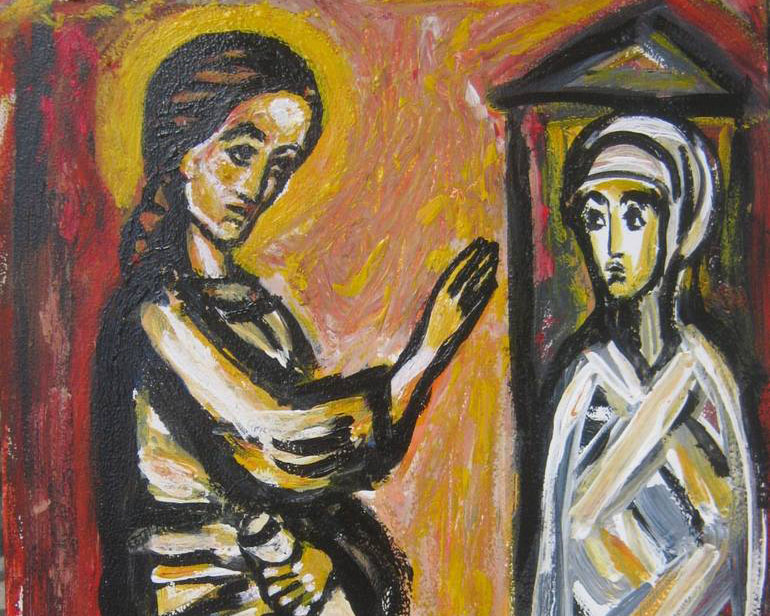
Cover image artist – Marlena Yurukova

 Rev Beck Newell