LENT 2, YEAR A
John 3:1-17
One of the most famous verses in the Bible comes from this passage—John 3:16. Even people who rarely attend church can quote it. But sometimes we know the verse without knowing the conversation that surrounds it. In today’s Gospel reading, we step into a quiet, personal meeting between Jesus and a searching man.
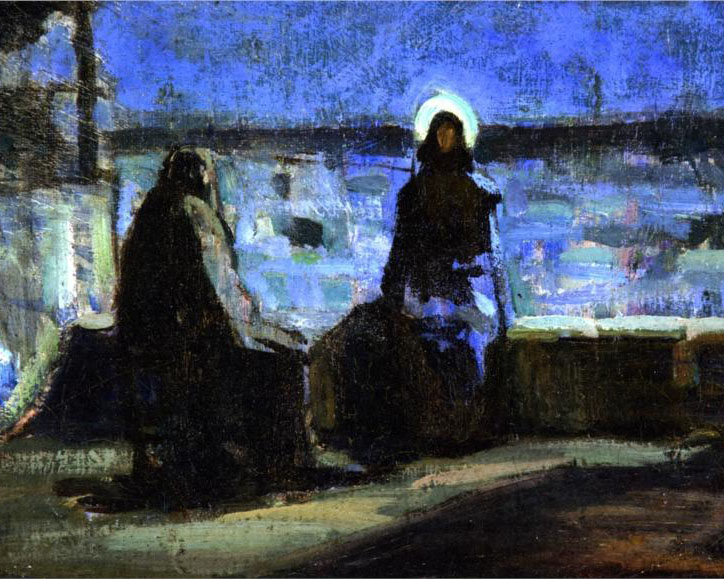
Verse one introduces us to Nicodemus. He was a Pharisee, a ruler of the Jews— educated, respected, morally disciplined. By all outward appearances, he had everything together. Yet he comes to Jesus at night.
Why at night? Perhaps he was cautious. Perhaps he didn’t want to be seen. Or perhaps night represents something deeper — spiritual darkness, questions, uncertainty.
Nicodemus says, “Rabbi, we know that you are a teacher come from God.” He recognizes something special in Jesus. But recognition is not the same as transformation.
And Jesus immediately moves past flattery to the heart of the matter: “Truly, truly, I say to you, unless one is born again he cannot see the kingdom of God.” Jesus does not say: “Unless you try harder.” “Unless you become more religious.” Or “unless you clean up your life.” He says: You must be born again.
Nicodemus is confused. “How can a man be born when he is old?” He is thinking physically. Jesus is speaking spiritually. Jesus clarifies: “Unless one is born of water and the Spirit, he cannot enter the kingdom of God…Flesh gives birth to flesh, but the Spirit gives birth to spirit.”
Here is the central truth: Religion can modify behaviour, but only the Spirit can transform a heart. Nicodemus had religion. He had knowledge. He had morality. But he needed life.
You can attend church and still need new birth.
You can know theology and still need new birth.
You can be respected and still need new birth.
Christianity is not self-improvement. It is spiritual resurrection.
Jesus uses the image of wind: “The wind blows where it wishes… You hear its sound, but you do not know where it comes from or where it goes. So it is with everyone born of the Spirit.”
The Greek word for “Spirit” and “wind” is the same — breath, air, invisible power.
You cannot see the wind, but you see its effects. Leaves move. Trees bend. Flags wave. You cannot see the Spirit, but you see the evidence: New desires, conviction of sin, love for God, changed lives.
New birth is not something we manufacture. It is something God does.
Jesus gently rebukes Nicodemus: “You are Israel’s teacher, and do you not understand these things?” The issue was not intelligence. It was spiritual blindness.
Then Jesus says something profound in verse fourteen: “Just as Moses lifted up the serpent in the wilderness, so must the Son of Man be lifted up.” Here, Jesus is referring to Numbers chapter twenty-one. The Israelites were dying from snake bites because of their sin. God told Moses to lift up a bronze serpent. Whoever looked at it in faith lived.
They did not earn healing. They did not work for healing. They simply looked and believed. In the same way, Jesus would be “lifted up” on a cross. Whoever looks to
Him in faith receives eternal life. Salvation is not achieved. It is received.
Then we arrive at John 3:16: “For God so loved the world, that He gave His only Son, that whoever believes in Him should not perish but have eternal life.”
Notice the words:
God loved. Salvation begins with God’s love.
God gave. Love is demonstrated through sacrifice.
Whoever believes. The invitation is open.
Not perish, but have eternal life. The stakes are eternal.
Verse seventeen continues: “For God did not send His Son into the world to condemn the world, but in order that the world might be saved through Him.” Jesus did not come primarily as a judge, but as a Saviour. Many people imagine God standing with folded arms, waiting to condemn. But this passage reveals a God who pursues, who loves, who gives. The cross was not an accident. It was an expression of divine love.
So, what does this mean for us?
This passage confronts us with three simple but life-altering truths:
We all need new birth. Not just the immoral. Not just the irreligious. Even the moral and religious.
New birth is God’s work. We respond in faith, but the Spirit gives life.
The invitation is open to “Whoever believes.”
You may feel like Nicodemus — curious, thoughtful, maybe even religious, but unsure.
The question is not: Are you informed? Are you sincere? Are you moral? The question is: Have you been born again? Have you looked to Christ in faith?
Imagine Nicodemus leaving that night. The conversation ends without telling us his immediate response. But we see him again later in the Gospel. In John chapter nineteen, after Jesus is crucified, Nicodemus helps bury Him.
The man who once came at night now steps into the light. Perhaps that night conversation changed everything. And it can change everything for you.
The wind is still blowing. The Spirit is still giving life. The Son has been lifted up. And the invitation still stands: “Whoever believes in Him shall not perish but have eternal life.” In the name of the Father, and of the Son, and of the Holy Spirit. Amen.
Cover image artist – Henry Ossawa Tanner

 Rev Beck Newell