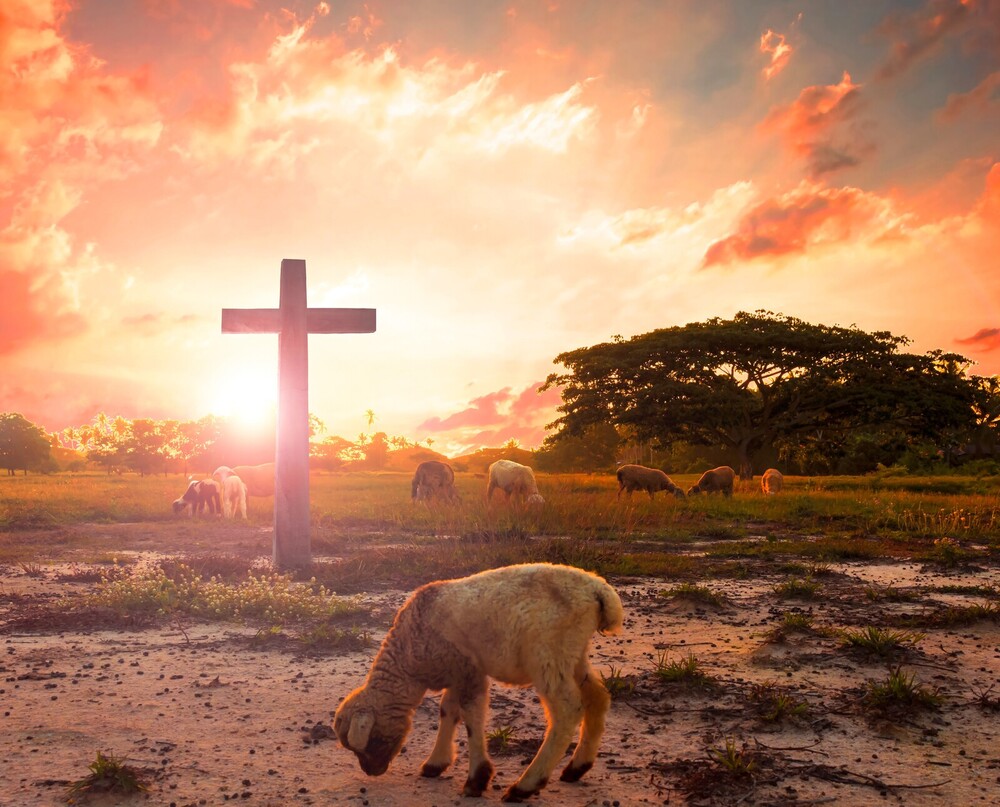
EPIPHANY 2, YEAR A
John 1:29-42
There is a moment in every faith journey when belief shifts from something we’ve heard about to someone we’ve encountered.
Our passage this morning is about that moment. It is about seeing, following, and discovering who Jesus really is—and then realising that once you do, you cannot keep it to yourself.
Today’s Gospel reading begins with John the Baptist doing what he has always done: pointing away from himself. In verse twenty-nine he says “Here is the Lamb of God who takes away the sin of the world!”
This is not sentimental language. A lamb in John’s world meant sacrifice. It evoked the Passover lamb, whose blood marked the doorposts of Israel in Egypt. It recalled the daily sacrifices in the temple.
John is saying: this is the one who will deal with sin, not symbolically, but finally.
Notice also what John does not say. He does not say, “Here is a great teacher,” or “Here is a moral example.” Those are also true, but they are not enough. John names Jesus as the one who takes away the sin of the world—not just individual guilt, but the brokenness, violence, and alienation that infects creation itself.
And John makes clear that Jesus’ identity is not his own invention: In verse thirty-one he says “I myself did not know him… but I came baptising with water for this reason, that he might be revealed to Israel.”
Faith begins not with certainty, but with witness. Someone else tells us where to look.
The next day, in verse thirty-six, John repeats himself: “Look, here is the Lamb of God!” This time, something changes. Two of John’s disciples hear him— and they follow Jesus.
This is important: they do not leave John because he has failed them. They leave him because he has succeeded. True spiritual leaders do not collect followers; they direct them toward Christ.
Jesus notices them following and asks in verse thirty-eight a simple but searching question: “What are you looking for?”
That question still echoes today. What are we looking for? Certainty? Comfort? Purpose? Healing? Belonging?
Jesus does not assume their motives—and he does not shame them for whatever they might be.
Their answer is cautious and respectful: “Rabbi, where are you staying?” It sounds like a small question, but it carries deeper meaning. They are really asking, Can we spend time with you? Can we get to know you?
Jesus does not give them a lecture. In verse thirty-nine, he gives them an invitation: “Come and see.” This may be the most important phrase in the passage.
Christianity does not begin with having all the answers. It begins with proximity. Come. Stay. Pay attention. See for yourself.
And they do. They remain with him that day. And somewhere between afternoon and evening, curiosity becomes conviction.
One of those disciples is Andrew. And what does Andrew do after meeting Jesus? Verse forty-one says “He first found his brother Simon and said to
him, ‘We have found the Messiah.’”
Andrew does not argue theology. He does not explain everything. He simply shares what he has experienced.
And then, in verse forty-two he does something even more important: “He brought Simon to Jesus.” That is evangelism in its simplest form: bringing someone to Jesus and trusting Jesus to do the rest.
When Jesus sees Simon, he speaks a word of transformation: “You are Simon son of John. You are to be called Cephas” (which is translated Peter). Before Simon preaches a sermon, before he understands the cross, before he fails and is restored—Jesus names who he will become. Grace sees not only who we are, but who we are becoming.
So, what does this mean for us?
This text invites us to ask three questions.
Firstly, who are we listening to? The voices we trust shape where we look. John the Baptist points away from himself toward Christ. Not every voice in our culture does that. Faith grows when we listen to witnesses who help us
recognise Jesus, not replace him.
Secondly, are we willing to follow before we fully understand? The first disciples do not have a creed yet. They have a direction. They follow because something in Jesus draws them. Faith often begins not with clarity, but with trust.
Thirdly, who might we bring with us? Andrew does not wait until he is an expert. He simply says, “Come and see.” You do not need perfect words to share faith—only a real encounter and a willingness to invite.
In conclusion, this passage reminds us that Christianity is not first about doctrines we defend, but about a person we follow. It begins with someone saying, “Look.” It continues with Jesus saying, “Come and see.” And it grows when we say to others, “We have found the Messiah.”
May we be people who keep looking, keep following, and keep bringing others into the presence of the One who takes away the sin of the world. Amen.

 Rev Beck Newell