EPIPHANY 3, YEAR A
Matthew 4:12-25
Matthew tells us that Jesus begins His public ministry at a moment of crisis. John the Baptist has been arrested. Hope seems threatened. The prophetic voice has been silenced. But instead of retreating, Jesus steps forward.
He leaves Nazareth and settles in Capernaum, in the region of Zebulun and Naphtali—an area often overlooked and looked down upon.
Matthew reminds us this is no accident. It fulfills Isaiah’s promise: “The people living in darkness have seen a great light.” This is how God works. When darkness deepens, God sends light. When fear grows, God draws near.
Jesus begins preaching with a simple but powerful message: “Repent, for the kingdom of heaven has come near.” This is not a threat—it is an invitation. God’s reign, God’s rule, God’s restoring power is no longer distant. It is within reach. And that announcement sets the stage for everything that follows.
As Jesus walks along the Sea of Galilee, He sees fishermen at work. Simon and Andrew are casting nets. James and John are mending theirs with their father. Nothing dramatic is happening—until Jesus speaks.
“Follow me, and I will make you fish for people.”
This moment teaches us something essential: the kingdom of God interrupts ordinary life. Jesus does not wait for people to come to Him; He goes to them. He meets them in their routine, their labour, their daily responsibilities.
And when He calls them, He doesn’t offer a detailed plan. He offers a relationship. “Follow me.”
Matthew tells us they respond immediately. They leave their nets, their boats, even their father. That detail matters.
The nets represent security and competence. These men know nets. They know how to throw them, mend them, read the water, judge the weather. Nets are the place where they are skilled, confident, useful. Leaving the nets means leaving mastery—stepping away from the thing that says, “I know who I am, and I’m good at it.”
The boats represent livelihood, capital, future planning. A boat is what keeps you afloat—literally and figuratively. To leave the boat is to release control over how tomorrow will be provided for. These fishermen are not walking away from failure; they are walking away from a system that worked.
And family represents economic, social, and moral identity. In the ancient world, to leave your father’s business was to disrupt expectations, inheritance, honour, and duty. This is not a rejection of family—but it is a reordering of allegiance.
Together, nets, boats, and family form a triangle of human security: nets are what I’m good at, boats are what keeps me safe, and family are who I belong to.
Jesus’ call touches all three.
For many, nets and boats don’t look like starting out anymore. They look like a life well built. Years of work. Responsibilities carried. Promises kept. They look like retirement plans, routines that give shape to each day, and a hard-earned sense of stability.
The nets are the skills and experience gathered over a lifetime—the things we know how to do well, the ways we’ve learned to cope, manage, and contribute.
The boats are the securities worked hard towards—the savings, the home, the carefully ordered life that finally feels settled.
And family means children, grandchildren, and the deep desire to protect, provide, and remain needed.
When Jesus calls here, the temptation isn’t failure—it’s completion. You may begin to think, “I’ve done my part. I’ve earned some rest.” And rest is good. But following Jesus has never had an age limit. Sometimes Christ’s call in this season is quieter but no less real: to loosen the grip on control, to trust God with loved ones rather than manage every outcome, to offer time, prayer, wisdom, and presence in unexpected ways.
For these fishermen, leaving the boat didn’t mean abandoning responsibility—it meant discovering that God still had more to do with their lives. And the same is true for us. The call of Jesus does not expire. It deepens.
Following Jesus is never about reckless abandonment. It’s about discovering that what we thought held us is not as strong as the One who calls us. Jesus never pretends following Him is easy—but He insists it is worth it.
And yet Jesus does not erase who these men are; He reshapes them.
“I will make you fish for people.”
They were fishermen—and Jesus uses that very image to describe their future. He takes what they know and transforms it for God’s purposes. This is how grace works. God doesn’t wait for perfect people; He forms faithful ones. He doesn’t discard our past; He redeems it.
Discipleship is not just about leaving behind an old life—it is about receiving a new purpose. Following Jesus means allowing Him to remake us, redirect us, and use us for something greater than ourselves.
Matthew now widens the lens. Jesus goes throughout Galilee: teaching in synagogues, proclaiming the good news of the kingdom, and healing every disease and sickness.
Notice the balance. Jesus speaks truth and shows compassion. He announces God’s reign and demonstrates it.
The kingdom is not just something to be believed—it is something to be experienced.
People bring the sick, the suffering, the demon-possessed, the paralysed—and Jesus heals them. This tells us something crucial about God’s heart: the kingdom draws near to broken people. No pain is too deep. No life is too far gone. Where Jesus reigns, restoration begins.
Large crowds begin to follow Jesus—from Galilee, the Decapolis, Jerusalem, Judea, and beyond the Jordan.
The light is spreading. The kingdom is moving outward.
But crowds are not the same as disciples. Some follow out of curiosity. Some follow for healing. Some follow because something in Jesus feels like hope. And Matthew quietly leaves the question hanging for us: What kind of followers will we be?
This passage shows us who Jesus is and what He brings: light in darkness, a call that changes lives, and a kingdom marked by grace, truth, and healing.
The same Jesus still walks into ordinary lives. The same call still sounds: “Follow me.” The same kingdom is still near.
The question is not whether the light has come. The question is whether we will turn—repent—and follow where Jesus leads. Amen.
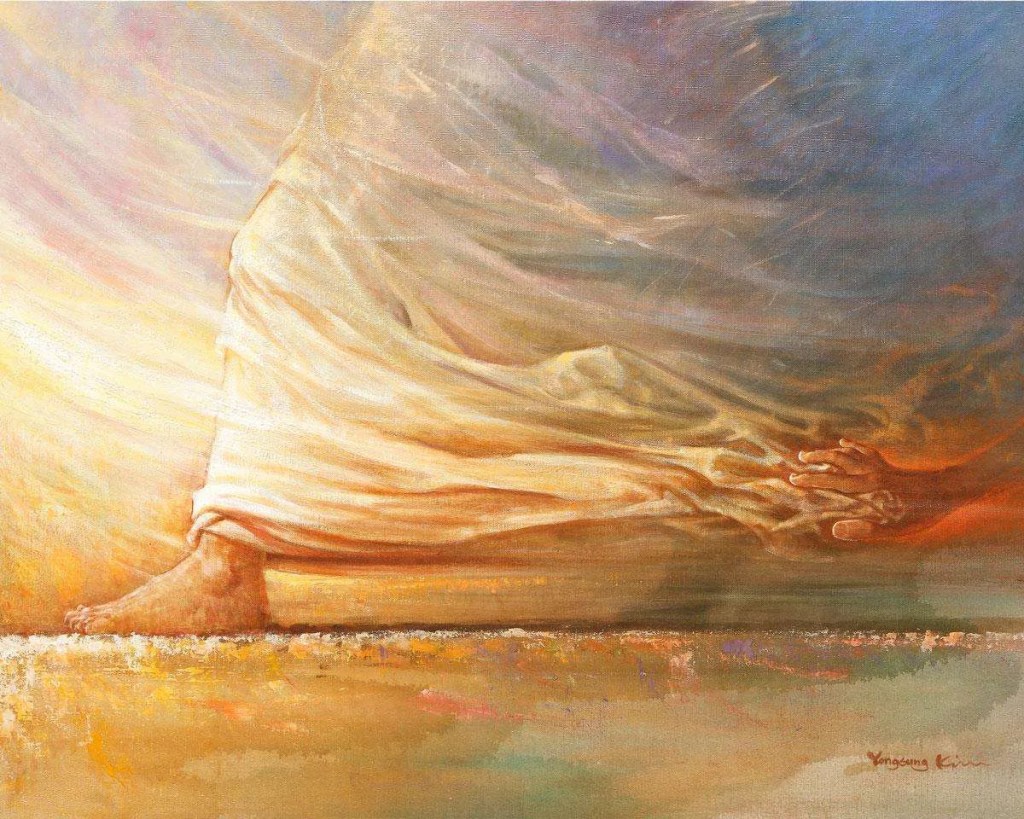
Cover image artist – Yongsung Kim

 Rev Beck Newell