YEAR A
Matthew 3:13-17
Picture a long line of people standing at the Jordan River.
They are not proud people. They are confessing people—admitting failures, regrets, and sins.
Now imagine someone steps into that line who clearly does not belong there. It would be like walking into an emergency room and seeing a perfectly healthy doctor lying on a stretcher, waiting to be treated.
Everyone would ask, “What are you doing here?”
That is the shock of today’s gospel passage. Jesus steps into the line with sinners.
And so, Jesus begins his public ministry. Not with a miracle, not with a sermon, not by claiming authority. He begins by standing in line with sinners.
Today’s gospel passage shows us not only who Jesus is, but what kind of God we serve—and what kind of life we are called into.
Jesus comes from Galilee to be baptised by John in the Jordan. The sinless One willingly identifying with sinners.
Jesus does not shout salvation from a distance. He steps into the same
water as broken people. From the very beginning of His ministry, Jesus shows us something essential about God: God is not distant. God is not repelled by human mess…God draws near.
And this is important. The gospel always begins with God moving toward us, not us cleaning ourselves up first.
In verses fourteen and fifteen there is a dialogue between John and Jesus.
John says ‘I need to be baptised by you, and do you come to me?’
John understands the problem. This feels backwards. The baptiser needs baptism. The prophet stands before the Holy One. It’s like a student insisting on grading the teacher’s exam, or a patient telling the surgeon, “No—you lie
down, I’ll take care of you.”
But listen to Jesus’ response: ‘Let it be so now; for it is proper for us in this way to fulfil all righteousness.’
Jesus is not saying, “This is convenient.”
He is saying, “This is obedience.”
To “fulfill all righteousness” means: To fully obey the will of the Father, To walk the path humanity failed to walk, and to submit Himself completely to God’s plan.
Jesus is showing us that righteousness is not just about avoiding sin—it’s about trusting obedience, even when it’s humbling.
The Son of God begins His ministry not by asserting His rights, but by surrendering to the Father’s will. Completely.
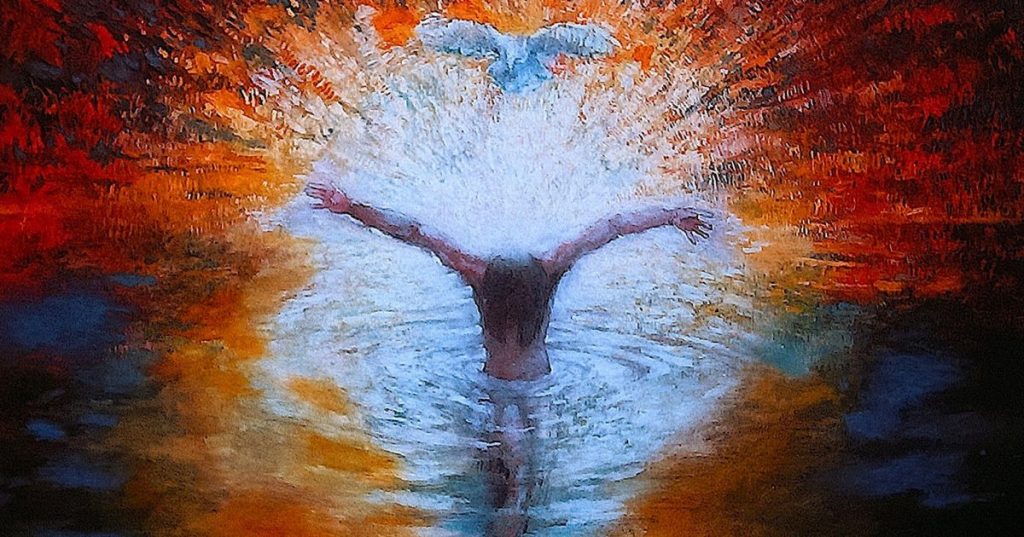
Verse sixteen paints a breathtaking picture. Jesus is baptised and comes up out of the water, the heavens open, and the Spirit like a dove descends upon him. The moment Jesus obeys, heaven responds.
Have you ever seen the sky break open after a long storm—clouds parting, light pouring through? You don’t cause the sun to shine, but you suddenly see what was always there.
That’s what happens here. God tears open heaven to declare: This is the
beginning of something new.
The Spirit descends like a dove—gentle, peaceful, and intentional. Just as the Spirit hovered over the waters in creation, the Spirit now rests on Jesus, signalling new creation has begun.
The final verse of the reading says “and a voice from heaven said, ‘This is my Son, the Beloved, with whom I am well pleased.’”
This is crucial. The Father speaks before Jesus preaches. Before He heals. Before He goes to the cross. The Father declares love and pleasure before performance. Jesus’ identity is not rooted in what He does, but in who He is. And this is life-changing for us.
So many people live trying to earn approval: from parents, from employers,
from society, even from God. But in Christ, God speaks over us the same truth: you are loved, you belong, you are mine. Through faith in Christ, we are adopted as children, not hired as servants.
In this moment, we see the Trinity fully present: The Son in the water, the Spirit descending, and the Father speaking.
This is not a distant or abstract God. This is a God deeply involved in redemption.
And notice what happens next in Matthew’s Gospel:
Jesus goes from the water to the wilderness… and eventually to the cross. The baptism points forward: to His identification with sinners, to His death and resurrection, and to our own baptism into His life. Jesus goes into the water so that one day He can go into the grave—and rise again for us.
So, what does that mean for us?
First, Jesus shows us the way of humility. Following Christ means surrender, not self-promotion.
Second, baptism matters. It doesn’t save us, but it publicly declares our identification with Jesus—just as He identified with us.
Third, our identity comes before our activity. We serve God not to earn love, but because we are loved.
Finally, this passage invites us to trust Jesus fully. The One who stepped into the water for us can be trusted with every part of our lives.
Imagine yourself standing at the Jordan. You expect judgment. You expect distance. Instead, Jesus stands beside you. The water ripples. Heaven opens. And God says, “This is my beloved Son.”
And, through Christ, that love reaches us.
May we trust the One who stepped into our place—and follow Him in humility, obedience, and faith. Amen.
artist – Daniel Bonnell

 Rev Beck Newell